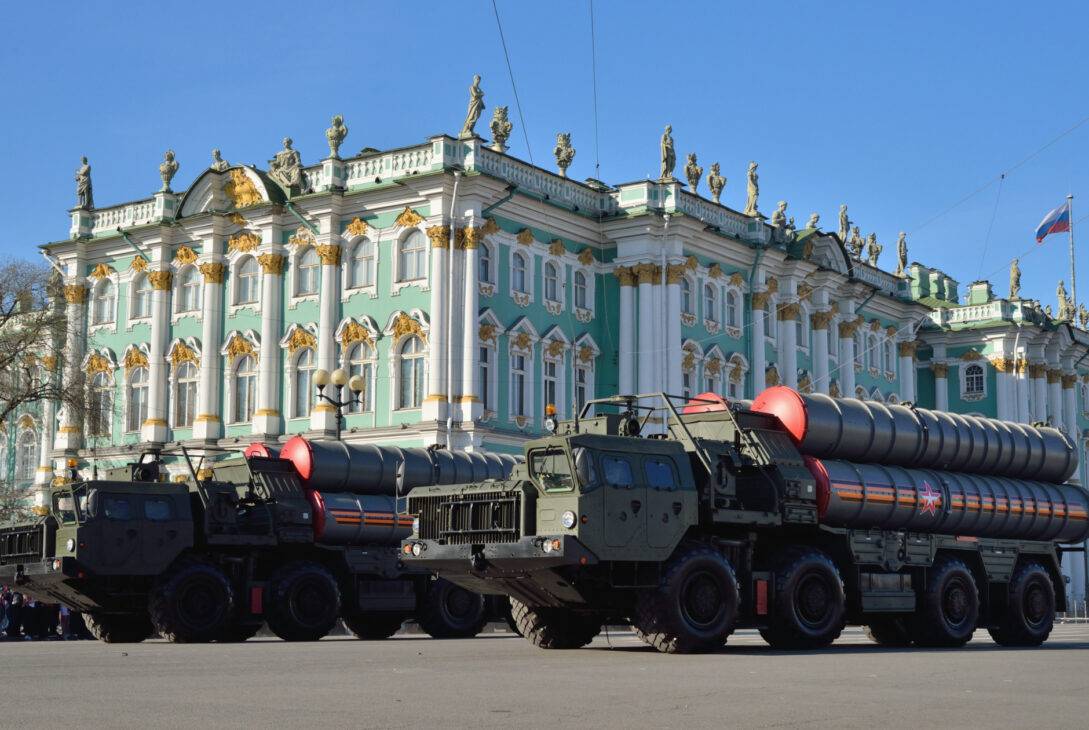
In an era of advanced military technologies and evolving aerial threats, nations worldwide seek robust air defense systems to protect their territories and critical assets. Among the most formidable solutions available today is the S-400 Triumf/SA-21 “Growler,” a sophisticated surface-to-air missile system developed by Russia.
Renowned for its exceptional range, speed, and versatility, the S-400 air defence system has redefined the paradigm of air defense, offering an unparalleled shield against a wide array of airborne threats.
Guarding the Skies
The S-400 serves as an advanced air defence system, capable of engaging and neutralising a broad spectrum of aerial threats. From combat aircraft and drones to ballistic missiles and hyper sonic glide vehicles, this system combines multiple components, cutting-edge radars, and versatile missile interceptors to ensure air superiority and protect critical assets.
Global Deployment
The first known use of the S-400 in combat was in Syria in 2018. The system was used to shoot down a Syrian Air Force Su-24 fighter-bomber that was flying over government-controlled territory.
The S-400 also reportedly shot down a number of cruise missiles fired by the United States and its allies during the 2019 strikes against Syrian chemical weapons facilities.
The S-400 has also been deployed in a number of other regions, including the Eastern Mediterranean, the Caucasus, and Central Asia. The system’s presence in these regions is seen as a deterrent to potential attacks by the United States or its allies.
S400 Deployment in Russia
The S400 air defence system is deployed in Russia in a number of locations, including:
- Crimea: The S-400 has been deployed in Crimea since 2014, after Russia annexed the peninsula from Ukraine. The system is seen as a deterrent to potential attacks from Ukraine or NATO countries.
- Kaliningrad: The S-400 has also been deployed in Kaliningrad, a Russian exclave located between Poland and Lithuania. The system is seen as a way to protect Russia’s Baltic Sea flank from NATO attacks.
- Moscow: The S-400 has been deployed around Moscow, the Russian capital. The system is seen as a way to protect the city from air attacks.
- Eastern Siberia: The S-400 has also been deployed in Eastern Siberia, near the border with China. The system is seen as a way to deter potential attacks from China.
Notable Purchases and Consequences
Turkiye’s (formerly Turkey) purchase of the S-400 air defence system from Russia in 2017 was a controversial move that has had a number of consequences for the country.
The use cases for the S-400 in Turkey are varied. The system could be used to defend against air attacks from neighboring countries, such as Syria or Iran. The S-400 could also be used to protect Turkey’s airspace from terrorist attacks. This was something that was particularly important to Turkiye mainly due to the buildup of heavily armed kurdish terror groups in northern Syria and of course the formation of DAESH terror cells in the region.
Turkiye’s decision to purchase the S-400 was seen by the United States as a threat to its security interests in the region.
The consequences of Turkey’s purchase of the S-400 have been significant. The sanctions imposed by the United States have damaged Turkey’s economy and have made it more difficult for the country to acquire advanced military technology. The suspension of Turkey’s participation in the F-35 program has also been a major setback for the Turkish military.
In addition to the economic and military consequences, Turkey’s purchase of the S-400 has also damaged its relations with the United States. The two countries have been long-time allies, but the S-400 deal has created a rift between them.
It is unclear how long this rift will last, but it is likely to have a significant impact on how Turkiye establishes its future security arrangements and how the US is able to exercise influence in the mediterranean and the middle east.
It is interesting to note that India also purchased the Russian S400 air defence system in 2018, One key difference between the Indian and Turkish cases is that the United States has not yet imposed sanctions on India. However India’s relations with the United States have certainly been damaged.
Key Features of the S400 Air Defence System
Radar Systems:
The S-400 features a multi functional radar system, incorporating multiple types of radars to provide comprehensive situational awareness. These radars include the 91N6E (Big Bird) acquisition and battle management radar, the 96L6E all-altitude surveillance radar, and the 92N6E (Grave Stone) fire control radar.
These radar systems work in tandem to detect, track, and classify aerial targets, ensuring early warning and accurate target engagement.
Missile Interceptors:~
The S-400 Triumf/SA-21 “Growler” employs a variety of advanced missile interceptors to engage and neutralise different types of aerial threats.
These include long-range missiles, such as the 40N6 with an extended range of up to 400 kilometres, as well as medium-range and short-range missiles, providing flexibility in engagements based on the target’s distance and altitude.
Working Mechanism:
The S-400 Triumf/SA-21 “Growler” operates on a highly integrated and autonomous network, combining radar systems, command centres, and missile launchers. Once a threat is detected and classified, the system’s command and control unit determines the optimal interception parameters and assigns the appropriate missile interceptor for engagement.
The missile interceptors, propelled by powerful rocket motors, are launched towards the target. Equipped with advanced guidance systems, these interceptors navigate towards their designated targets, employing kinetic energy or proximity-fused explosive warheads to neutralize them. The system’s radar continues to track the target, providing real-time updates for precise interception.
Extended Engagement Range:
The S-400 Triumf/SA-21 “Growler” is renowned for its exceptional engagement range. With its long-range missiles, the system can intercept airborne threats at considerable distances, offering an extensive defensive envelope and increasing the protected airspace.
Multi-Target Engagement:
The system’s advanced radar systems and missile interceptors enable it to engage multiple targets simultaneously, ensuring comprehensive coverage and defence against coordinated aerial attacks. This multi-target engagement capability bolsters the system’s effectiveness in countering saturation tactics employed by adversaries.
Countermeasure Resistance:
The S-400 Triumf/SA-21 “Growler” is equipped with countermeasure resistance features, making it highly capable of countering various countermeasures deployed by incoming threats. These countermeasures include electronic warfare systems, decoys, and maneuvering targets.